[01]
arXiv
• preprint Simulation-Driven RF Sensing
Dual-Attention and Adversarial Transfer Networks for Sim-to-Real Cross-Orientation Wireless Sensing
arXiv Preprint , Aug, 2026.
Millimeter-wave (mmWave) human activity recognition degrades significantly when the user's orientation changes relative to the sensing links, because orientation shifts distort the Doppler signature and increase intra-class variance. Existing cross-domain wireless sensing methods either synthesize target-domain samples or learn domain-invariant features, but both remain dependent on measured multi-orientation data, and labeling such data for every orientation is labor-intensive.
This project develops S2M-Sense, a simulation-to-reality platform for cross-orientation activity recognition. Its objectives are:
S2M-Sense targets indoor activity recognition for smart homes, healthcare monitoring, and human-computer interaction, where cameras raise privacy concerns and wearable devices impose a burden on users. The person may perform an activity facing any direction within the joint coverage of two near-orthogonal mmWave communication links, which provide complementary views of the same motion.
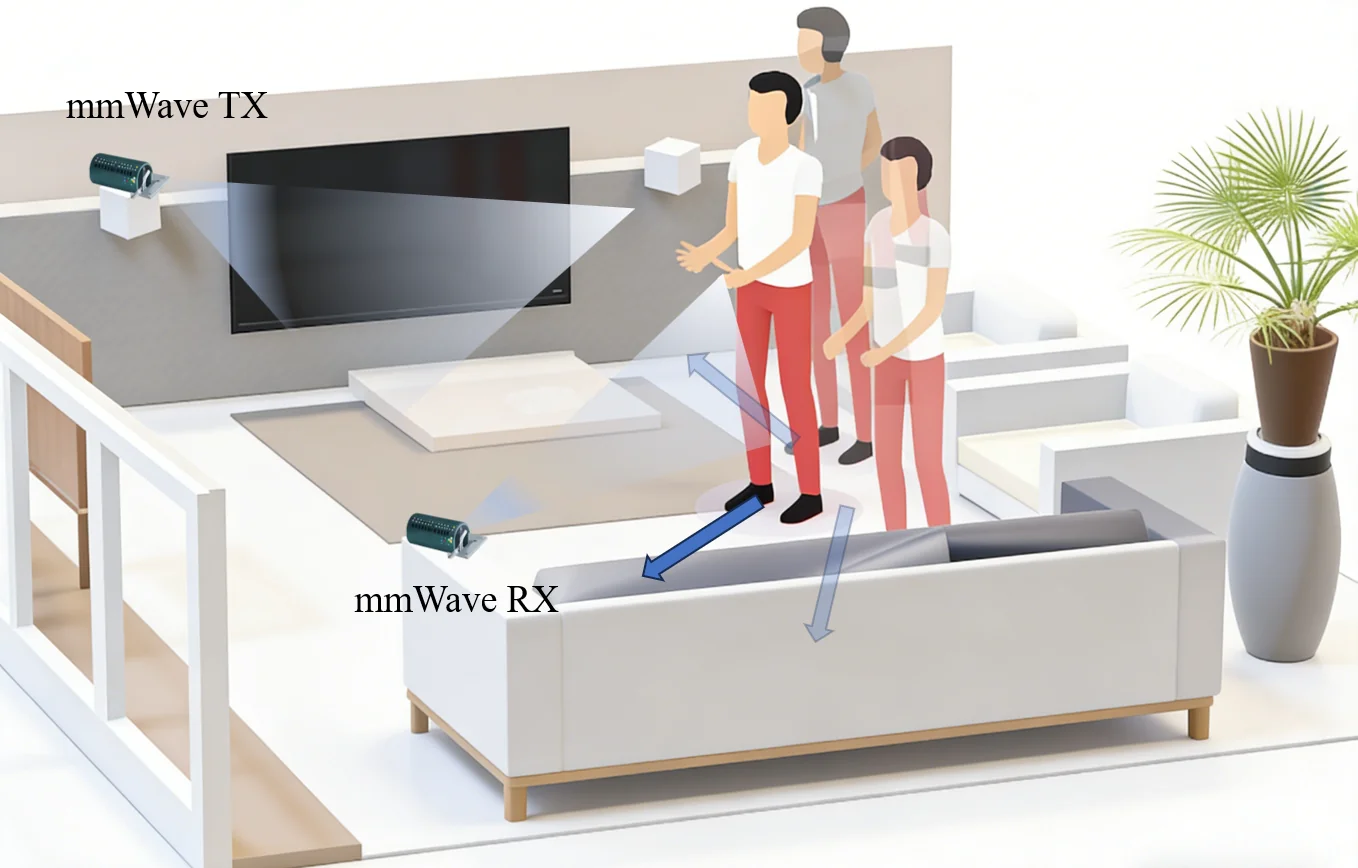
Figure 1: Indoor passive sensing with a mmWave transmitter and receiver, where users perform activities at arbitrary orientations.
Sensing is passive and reuses OFDM communication signals. At the receiver, a reference channel and a surveillance channel are processed with the cross-ambiguity function (CAF) to obtain one Doppler spectrogram per link.
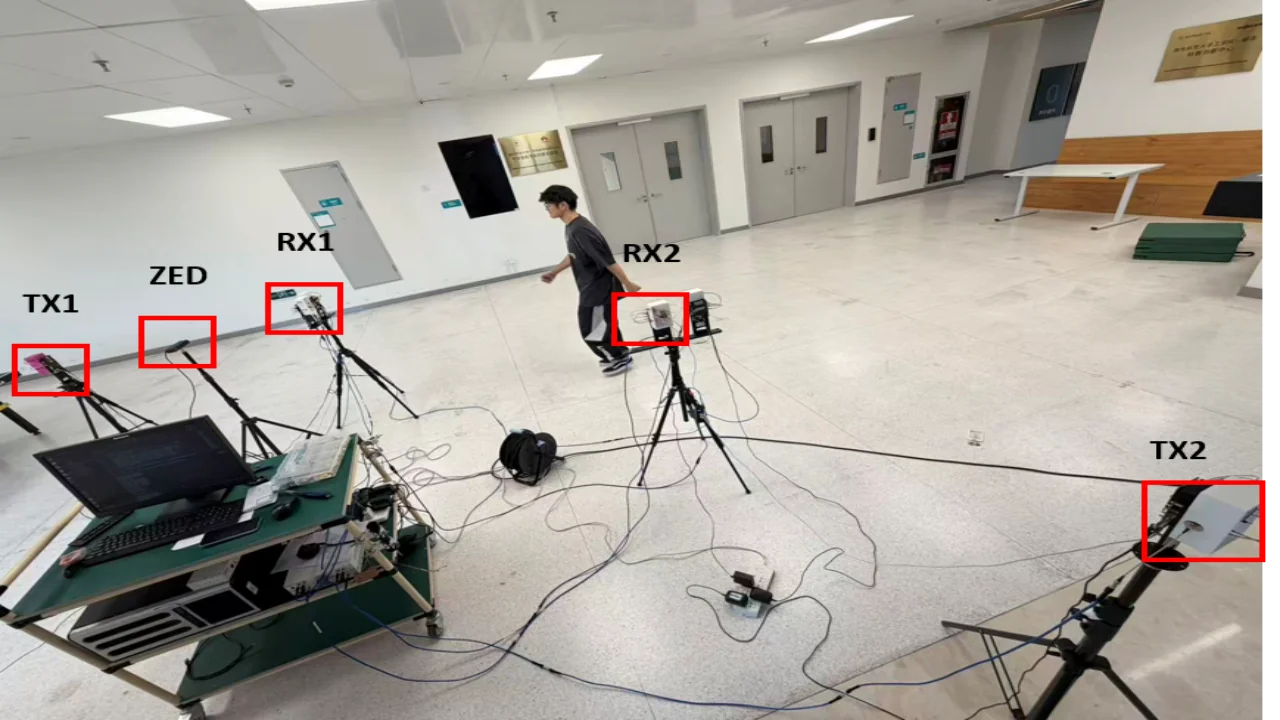 Figure 2: Experimental layout of the dual-link 60 GHz passive sensing system.
S2M-Sense consists of four components: channel-simulator-driven data generation, measured Doppler capture, dual-attention feature extraction, and simulation-to-reality transfer learning.
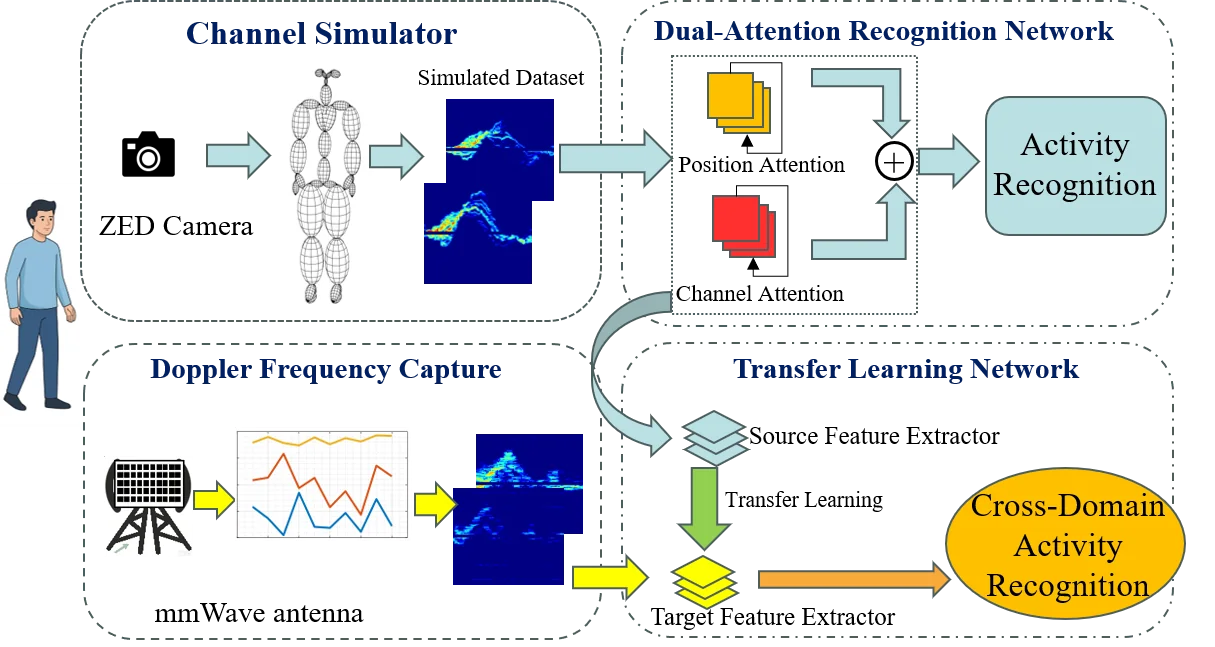 Figure 3: Architecture of S2M-Sense, combining the channel simulator, measured Doppler capture, the dual-attention recognition network, and the transfer learning network.
Channel Simulator: A depth camera estimates 34 body keypoints per frame, and adjacent keypoints are connected by ellipsoidal primitives. Under the quasi-static assumption, the channel impulse response (CIR) is , where is the target-related component and captures line-of-sight and static-scatterer paths. The contribution of the -th primitive is
where the angle-dependent antenna gains follow the array factor of the Sivers uniform linear array. Motion sequences are refined by cubic spline interpolation and a One-Euro filter.
Orientation Expansion: Multi-orientation data are generated by rotating all keypoints by an angle about a vertical axis through the waist keypoint, using a homogeneous transformation . The CIR is then recomputed for each target orientation, so a single recorded motion yields training samples over the full azimuth range.
Dual-Attention Network: Spectrograms from the two links are encoded by ResNet-18 into , concatenated along the channel dimension, and batch-normalized. A position attention module captures long-range spatial dependencies, while a parallel channel attention module emphasizes activity-related channels and suppresses orientation-sensitive ones. The outputs are fused through a residual connection, , where and are learnable weights initialized to zero.
Adversarial Unsupervised Transfer Learning: The source feature extractor and classifier are pre-trained on labeled simulated data. A target extractor , initialized from , is fine-tuned against a domain discriminator using unlabeled measured samples, alternating between
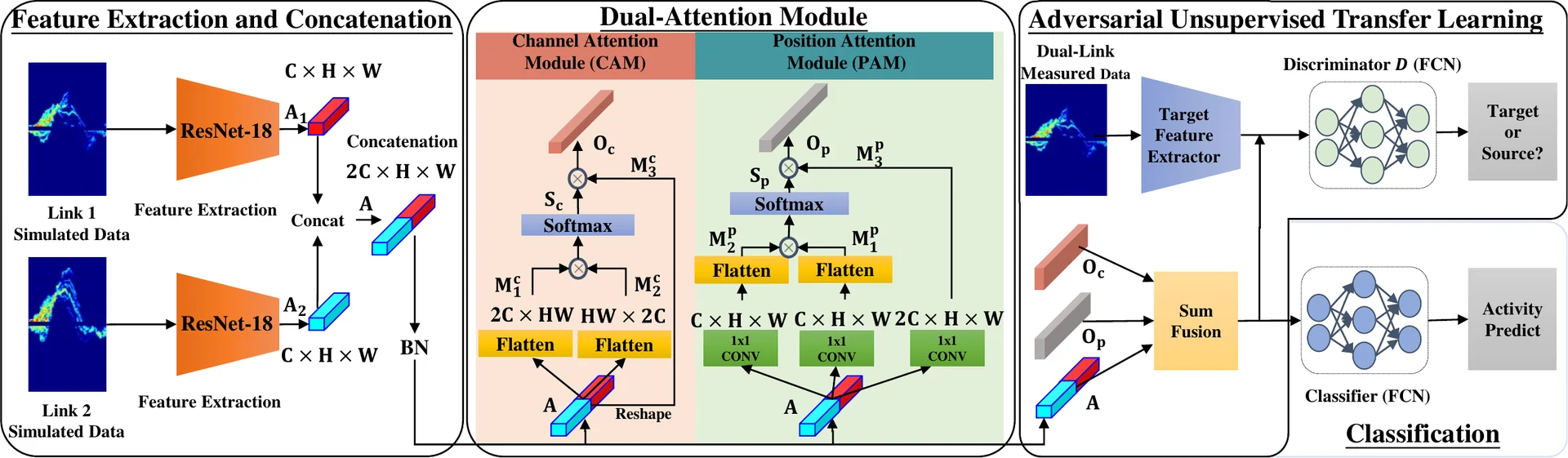 Figure 4: Dual-link feature extraction and concatenation, the parallel channel and position attention modules, and adversarial unsupervised transfer learning for activity classification.
The platform was evaluated on four activities (step, fall, sit, and kick) using a 60 GHz passive sensing testbed. Simulated training data and measured test data come from disjoint groups of volunteers to avoid identity leakage.
| Parameter / Component | Specification |
|---|---|
| Carrier Frequency | 60.48 GHz |
| Baseband Platform | NI USRP-2954R |
| RF Front End | Sivers phased-array antennas; two synchronized arrays capture reference and surveillance channels |
| Waveform | Training sequence with OFDM payload |
| Motion Capture | ZED 2i depth camera at 30 fps, interpolated to 2000 fps |
| Simulated Training Set | 3000 spectrograms from 10 single-orientation videos of three volunteers, orientations sampled over – |
| Measured Test Set | 480 spectrograms from three other volunteers at , , , and |
| Training | Adam, learning rate , 200 epochs, batch size 16 |
The simulator preserves the dominant Doppler structure of each activity, although measured spectrograms still contain clutter and amplitude distortions. Across all four activities and four test orientations, the structural similarity index measure (SSIM) between simulated and measured spectrograms ranges from 0.79 to 0.89.
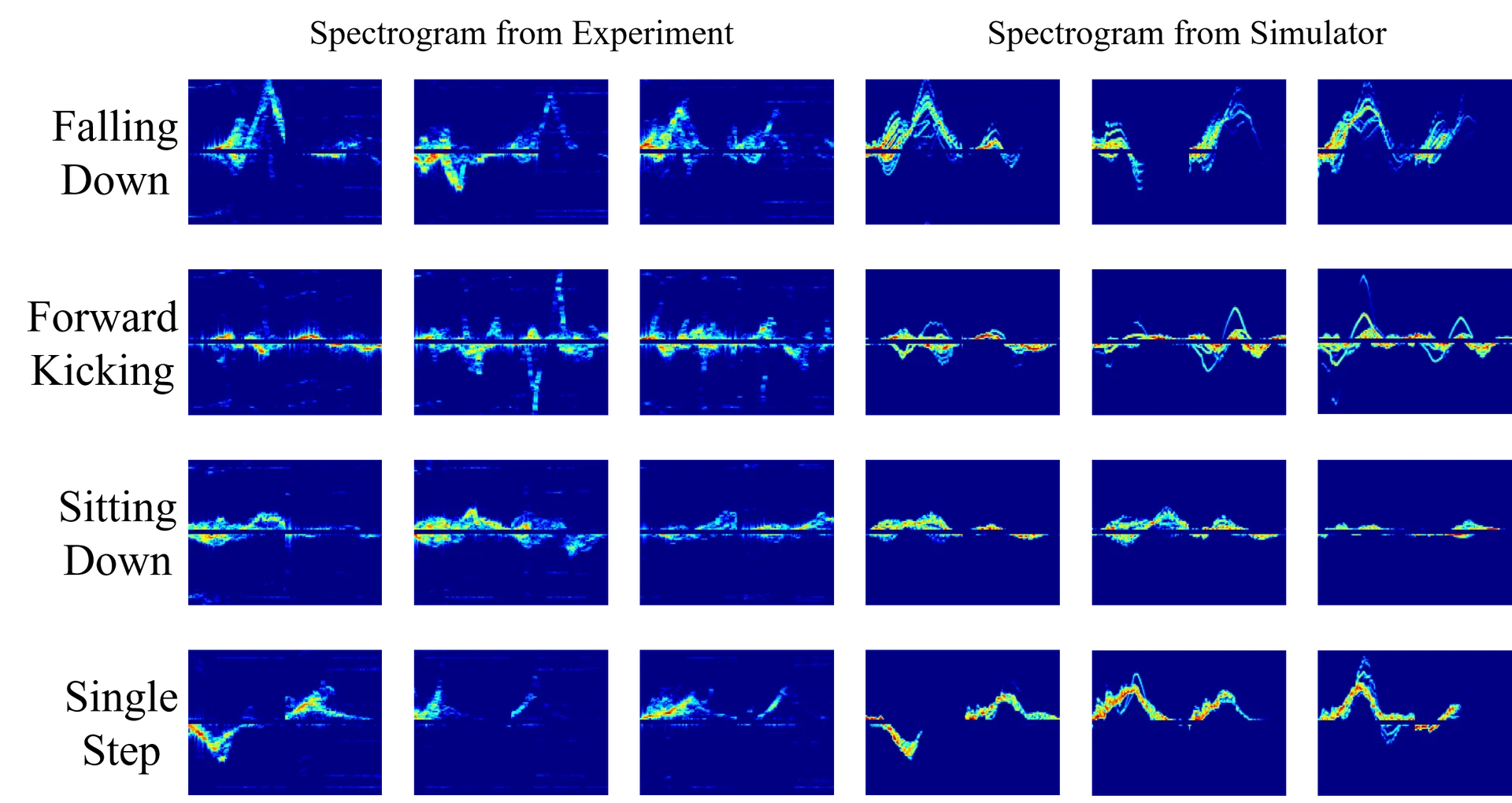 Figure 5: Doppler spectrograms from the experiment (left) and the channel simulator (right) for falling down, forward kicking, sitting down, and single step.
All baselines were retrained on four simulated datasets: single-orientation, Link 1 with multi-orientation, Link 2 with multi-orientation, and dual-link with multi-orientation, and evaluated on the same measured test set. The proposed method outperforms WiDual, WiGRUNT, and ImgFi on all four datasets, with the best result obtained on the dual-link multi-orientation dataset.
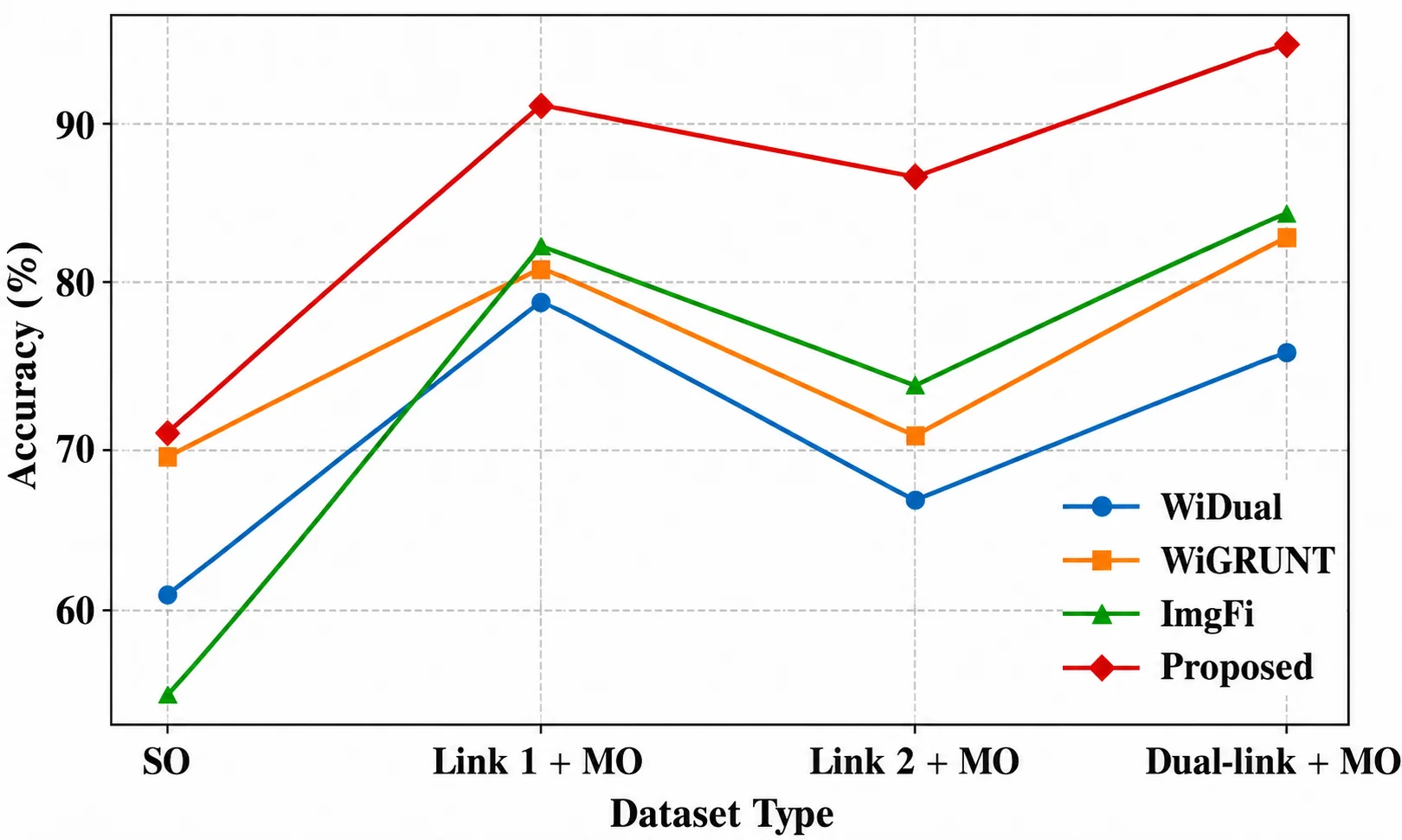 Figure 6: Recognition accuracy of the proposed method and cross-domain baselines trained on four types of simulated datasets.